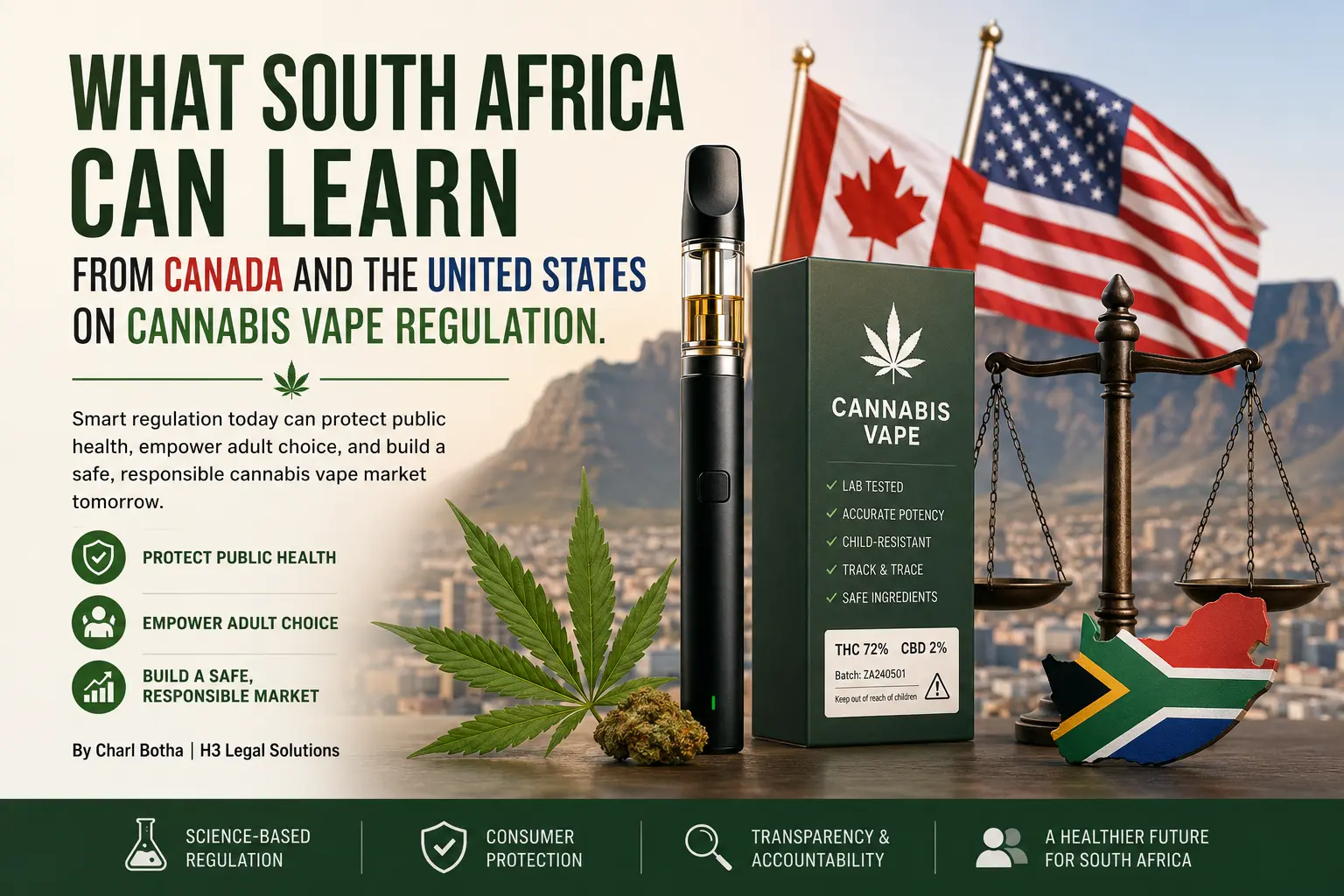
What South Africa Can Learn from Canada and the United States on Cannabis Vape Regulation.
By Charl Botha | H3 Legal Solutions
South Africa’s cannabis vape market is growing rapidly in the grey space between legal reform and practical regulation. While adult private use enjoys constitutional protection, cannabis vape devices create a distinct public-health and consumer-protection risk when they circulate without clear safeguards. The good news is that South Africa does not need to invent solutions from scratch.
Canada and the United States offer two contrasting experiences. Canada demonstrates the benefits of a structured national regulatory framework. The United States illustrates the serious dangers of regulatory fragmentation and delayed intervention.
Neither model is perfect for South Africa, but both contain hard-earned lessons we would be foolish to ignore.
South Africa should learn before harm forces reaction
Cannabis vape products are not simply another form of cannabis; they are sophisticated inhalation delivery systems. Risks can arise from the cannabis extract, carrier liquids, flavourants, additives, residual solvents, device components, battery safety, and inaccurate potency claims. This demands a much higher standard of care than the private use of dried flower.
South Africa’s challenge is to protect constitutional privacy-based adult use while preventing unsafe, misleading, or youth-attractive products from spreading through the market.
Canada: Control the product before it reaches the consumer
Canada took a national approach under its Cannabis Act. Vape products were brought under licensing requirements, good production practices, strict packaging and labelling rules, and traceability systems.
The central lesson is early control. Regulators demand answers to key questions before products reach consumers: Who produced it? What exactly is inside? What is the verified potency? Is it traceable? Can it be recalled if problems arise?
Canada’s practical tools South Africa can adapt
- Licensed production and supplier accountability Cannabis vapes should have a clearly identifiable, accountable producer, processor, or supplier. Once cannabis is extracted, concentrated, and packaged for inhalation, product safety and traceability must become non-negotiable.
- Good Production Practices (GPP) South Africa should establish minimum standards covering ingredients, contamination control, testing, storage, and record-keeping for any inhalable cannabis product.
- Strict packaging and labelling controls Labels must prioritise consumer safety over marketing appeal. Requirements should include full ingredient lists, accurate potency information, standardised health warnings, batch numbers, and child-resistant packaging. Youth-oriented flavours, cartoonish designs, and misleading wellness claims should be heavily restricted.
- Potency verification and visibility Clear THC/CBD labelling and plain-language warnings are essential. Consumers must understand the difference between low- and high-potency products, especially with fast-acting inhaled formats.
- Pre-market notification or registration Requiring advance notice of new vape products allows regulators to monitor what is entering the market and assess basic safety information.
The United States: Fragmentation creates public-health danger
The US experience shows what happens when regulation is fragmented across federal and state levels. Informal and illicit supply channels flourished alongside regulated markets, creating major risks.
The most sobering example remains the 2019–2020 EVALI (e-cigarette or vaping product use-associated lung injury) outbreak. Most cases were linked to THC-containing vapes from informal sources, with vitamin E acetate strongly identified as a key culprit. This outbreak demonstrated how quickly harm can escalate when consumers cannot reliably know what they are inhaling.
What the EVALI outbreak teaches South Africa
- Informal sources dramatically increased risk, Most EVALI cases were tied to THC vapes bought from informal channels, street dealers, friends, or unregulated online sellers. In those settings, there is no testing, no quality control, and no one to hold accountable. South Africa already has a strong informal cannabis market. If vape products follow the same path, we risk exposing users to dangerous concentrations and unknown substances with no safety net.
- Additives safe in other contexts can become dangerous when heated and inhaled, Vitamin E acetate was widely used as a cutting agent because it was cheap and gave vapes a smooth feel. It is considered safe in food and skin products, but when heated and inhaled deep into the lungs, it caused serious harm. South Africa must evaluate every ingredient, carrier liquid, and additive specifically for inhalation safety, not simply borrow safety data from other uses.
- Professional-looking packaging can create false legitimacy, Many of the problematic vapes looked clean and professionally branded, complete with strain names, potency claims, and sleek designs. Consumers assumed they were safe. In reality, they were often counterfeit or poorly made. South Africa cannot rely on appearances. We need clear rules so that only lawfully produced, tested products can carry proper branding and packaging.
- Adverse event reporting systems must exist before a crisis, When people started getting sick, there was no quick, centralised way for doctors and patients to report problems and connect the dots. By the time authorities acted, hundreds were hospitalised and several died. South Africa must set up a simple, accessible reporting system now, linked to SAHPRA or the Department of Health, so we can catch problems early rather than after harm has already spread.
- Clear, proactive public messaging is critical. During the EVALI outbreak, mixed and delayed messages left the public confused. South Africa should prepare straightforward public guidance in advance: what to watch out for, which products carry higher risk, and where to seek help. Clear communication protects people and stops panic from taking over.
What South Africa should avoid
We have the advantage of seeing other countries’ mistakes before our own market grows larger. There are four key errors we must not repeat:
- Treating concentrated vape products the same as private dried flower use. The Constitution and the Cannabis for Private Purposes Act protect adult use in private. But a vape cartridge is a processed, concentrated delivery system. It carries different risks around potency, additives, and inhalation. We cannot apply the same light-touch rules to both.
- Creating rules so burdensome that only the informal market can thrive. Overly complicated or expensive regulations will simply push responsible operators out and leave the field wide open to illegal suppliers. Any framework must be practical, especially for smaller South African businesses.
- Allowing untested, unlabelled, or youth-targeted products to circulate freely. Sweet flavours, bright packaging, and wild health claims are designed to attract young people and casual users. Letting these products move unchecked is asking for trouble, both in terms of public health and future political backlash.
- Waiting for hospital cases or media scandals before acting. Reactive policy always costs more — in lives, trust, and money. South Africa still has time to get ahead of the curve instead of scrambling once the first cluster of cases appears in the news.
A realistic South African framework
South Africa must build its own solution, one that respects the Cannabis for Private Purposes Act and our constitutional values, while treating vape products with the seriousness they deserve. Here is what a practical, balanced framework should include:
- Clear distinction between private adult use, medical access, and commercial supply. Keep private use protected, but draw a firm line when products are manufactured, packaged, and supplied to others.
- Specific classification of cannabis vapes as higher-risk inhalable products. Treat them separately from flower or edibles, with stricter rules because they go straight into the lungs.
- Strict age restrictions and child-protection measures. Mandatory ID checks, child-resistant packaging, and heavy penalties for anyone who supplies vapes to minors.
- Mandatory testing for potency, contaminants, residual solvents, and additives. Independent lab testing must be required before any vape product can be sold. independents.
- Full ingredient disclosure and prohibited substance lists. Consumers must know exactly what is inside, every cannabinoid, flavourant, and carrier. Maintain a banned list of dangerous additives.
- Plain-language health warnings. Simple, visible warnings about impairment, lung risks, pregnancy, and addiction, not small legal fine print.
- Batch traceability. Every vape cartridge or device must carry a batch number so it can be tracked back to the producer if something goes wrong.
- Adverse event reporting systems, an easy, well-publicised system for doctors and users to report problems quickly.
- Clear rules so that unsafe batches can be pulled from the market fast, with proper notification to buyers.
- Packaging and marketing restrictions (no youth appeal). Ban cartoon designs, confectionery flavours, and any marketing that targets or attracts young people.
- Supplier accountability. Every commercial supplier must be identifiable and legally responsible for the safety of what they put into the market.
- Enforcement against counterfeit and unsafe products. Give authorities practical powers and resources to seize dangerous vapes and prosecute reckless suppliers.
- Public education for consumers, healthcare workers, and enforcement officials. Run ongoing campaigns so everyone understands the risks, the rules, and how to stay safe.
The central principle is accountability
Canada shows that accountability can be built into the system through licensing and standards. The United States warns that the absence of accountability turns consumers into unwitting test subjects.
South Africa has the opportunity to build a balanced framework — one that protects adult privacy rights, supports responsible medical access, safeguards children and public health, and gives lawful operators clarity while isolating reckless actors.
The cannabis vape issue is already present in the market. Silence is not neutral. South Africa should choose evidence-based, harm-reduction policy now, rather than crisis management later.
Charl Botha is a South African legal and compliance strategist with extensive experience in criminal law, labour law, commercial law, litigation support, contract drafting and regulatory risk analysis. Through H3 Legal Solutions, he focuses on developing legally defensible governance, compliance and operational frameworks for complex and high-risk sectors, including South Africa’s emerging cannabis industry. His work combines legal reasoning, practical risk management and structured documentation to support lawful participation, accountability and institutional integrity.

 By Charl Botha




Share this page with your family and friends.