
Notifications
Charl Botha Thu at 10:07 AM 8 minutes, 49 seconds
14 views 0 Comments 0 Likes 0 Reviews
In the 6 March 2026 briefing to the Portfolio Committee on Trade, Industry and Competition, one quiet but critical issue cut through the presentations more sharply than any policy disagreement: there is still no single, agreed picture of the size of South Africa’s cannabis market. Different figures were presented R5.5 billion, R14 billion, R28 billion each reflecting a different definition of what is being measured. Legal activity, projected growth, and the total market (including the massive informal trade) were being discussed interchangeably, without a unified baseline.
For a parliamentary committee tasked with shaping industrial policy and the National Cannabis Master Plan, this is not a minor statistical quibble. It is a foundational problem. When the numbers keep shifting depending on who is speaking, Parliament loses a shared point of reference. The scale of the opportunity, the urgency of reform, and the level of intervention required all become blurred. Fragmentation in the evidence base weakens decision-making at the highest level.
The Market That Already Exists
The difficulty in pinning down the cannabis economy is not caused by a lack of activity. It is the opposite. The market is already operating at scale jus,t unevenly, informally, and largely unmeasured in any structured way.
From ground-level observation, approximately 8,500 stores and an estimated 2,500 clubs form the backbone of a retail network that functions daily, regardless of its legal status. These range from small operators turning over less than R100,000 a month to high-volume outlets moving close to R100,000 a day. This is not a marginal or emerging economy. It is a distributed, functioning market already embedded across cities, towns, and rural supply chains.
What Makes Up the Number
The value is not built on a single product. It is layered:
Because different analysts measure different slices of the same system, the headline figures vary widely. The real economy before full legalisation already supports jobs in cultivation, processing, retail and distribution; rental income for commercial spaces; secondary services such as logistics and security; and even VAT on non-cannabis components of sales.
The Informal Market Is the Real System
Estimates presented to the committee indicate that as much as 98 % of the cannabis activity operates informally. Yet this market does not need to be inferred from a single top-down number, it can be observed from the ground up.
Production flows continuously across traditional rural growing regions and urban/peri-urban operations. Licensed facilities add controlled output (much of it still export-focused). Retail is visible and stable: thousands of outlets are consistently stocked and restocked. Product diversity, flower in multiple price bands, vapes, and edibles , confirms a functioning supply chain. Shops pay rent. Staff are employed. Packaging is printed. Transport moves product daily. Money changes hands across roughly 11,000 points of sale.
A bottom-up model built from observed production, processing, and retail flow places South Africa’s cannabis retail economy at approximately R9–10 billion annually. This estimate is anchored in roughly 550 tons of flower moving through the system, realistic pricing (R6/g at production, R9/g wholesale, R18/g retail), and per-outlet turnover that aligns with visible activity. It avoids double-counting and reflects a scaled market that exists in practice, not theory.
Licensed Businesses Are Operating Without a Market
At the same time, a quieter and more serious reality emerged. Licensed operators who have complied fully investing in facilities, meeting regulatory standards, and entering through the formal pathway are struggling. There is still no functional domestic market available to them. Export remains complex, expensive, and highly competitive. Meanwhile, the informal market operates without the same compliance costs and undercuts prices.
This is not a simple “illegal vs legal” tension. It is a structural mismatch: the legal market exists without a corresponding domestic market in which to participate. Compliance does not yet translate into commercial viability.
The System Is Being Built in Reverse
Edibles, far from being a side issue, served as a clear regulatory signal during the session. Health authorities highlighted delayed onset, dosing uncertainty, and their appeal to new consumers not to slow the market, but to illustrate why structured controls are essential before expansion.
What the session revealed is that South Africa’s cannabis system is being constructed in reverse. Cultivation is active. Consumption is widespread. A regulated medical framework is already in place. What is missing is the critical middle layer, lawful trade, distribution, aggregation, and retail pathways that connect supply to market.
In most industries, that middle layer is established early. Here it is being added last. The result is a gap where supply and demand both exist, but the legal mechanism linking them remains undefined. The informal market has simply filled the void.
No Disagreement Only Lack of Integration
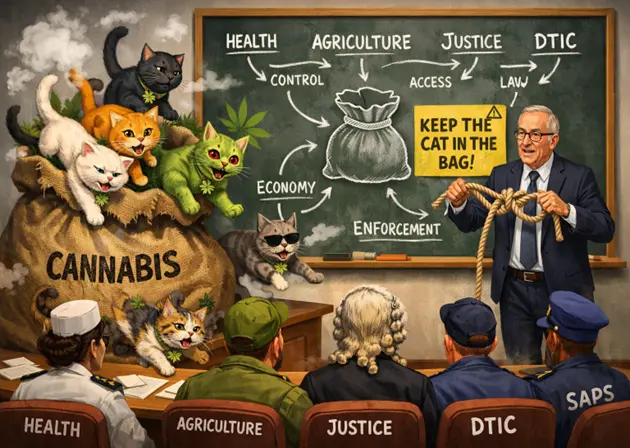
Importantly, there is no fundamental policy conflict across departments. Health focuses on risk and safety. Agriculture on access and participation. Trade and Industry on economic potential. Justice on legal boundaries. Each mandate is valid. The issue is not disagreement. It is the absence of integration. These perspectives operate in parallel rather than as parts of a single, aligned framework.
Key Takeaway
The cannabis economy is not something Parliament must create. It already exists at scale, visibly, and measurably. The real policy challenge is no longer “how do we stimulate a market?” but “how do we bring an existing R9–10 billion market into the formal, taxable, and regulated economy?”
Until Parliament works from one clear, evidence-based number and one coherent view of the system, the numbers will continue to vary, not because the market is unclear, but because only parts of it are being seen. Closing the data gap and defining the missing middle layer of the value chain is now the decisive next step in turning constitutional rights and policy intent into a functioning, inclusive industry.
Charl Botha is a legal strategist, cannabis policy specialist, and founder of H3 Legal Solutions (Pty) Ltd. With a B.Proc degree and deep operational insight into South Africa’s cannabis sector, he writes and briefs on the practical intersection of constitutional rights, industrial policy, and responsible commercialisation.





Share this page with your family and friends.